Commuting in Greater Ann Arbor: A Strategic Evaluation Guide
If you are considering a move to the Greater Ann Arbor area, you have likely already encountered the “Ann Arbor Paradox.” The region is an exceptional hub for employment, healthcare, and education, but navigating it—specifically during peak hours—requires a deliberate strategy.
The days of simply looking up driving directions are over. With downtown parking costs rising and high-efficiency transit options expanding, the smartest commute isn’t always behind the wheel of your own car. Whether you are commuting from nearby communities like Whitmore Lake or navigating within the city limits, your choice of transport impacts your budget, your schedule, and your daily stress levels.
This guide moves beyond basic route maps to help you evaluate the true cost and convenience of your transportation options.
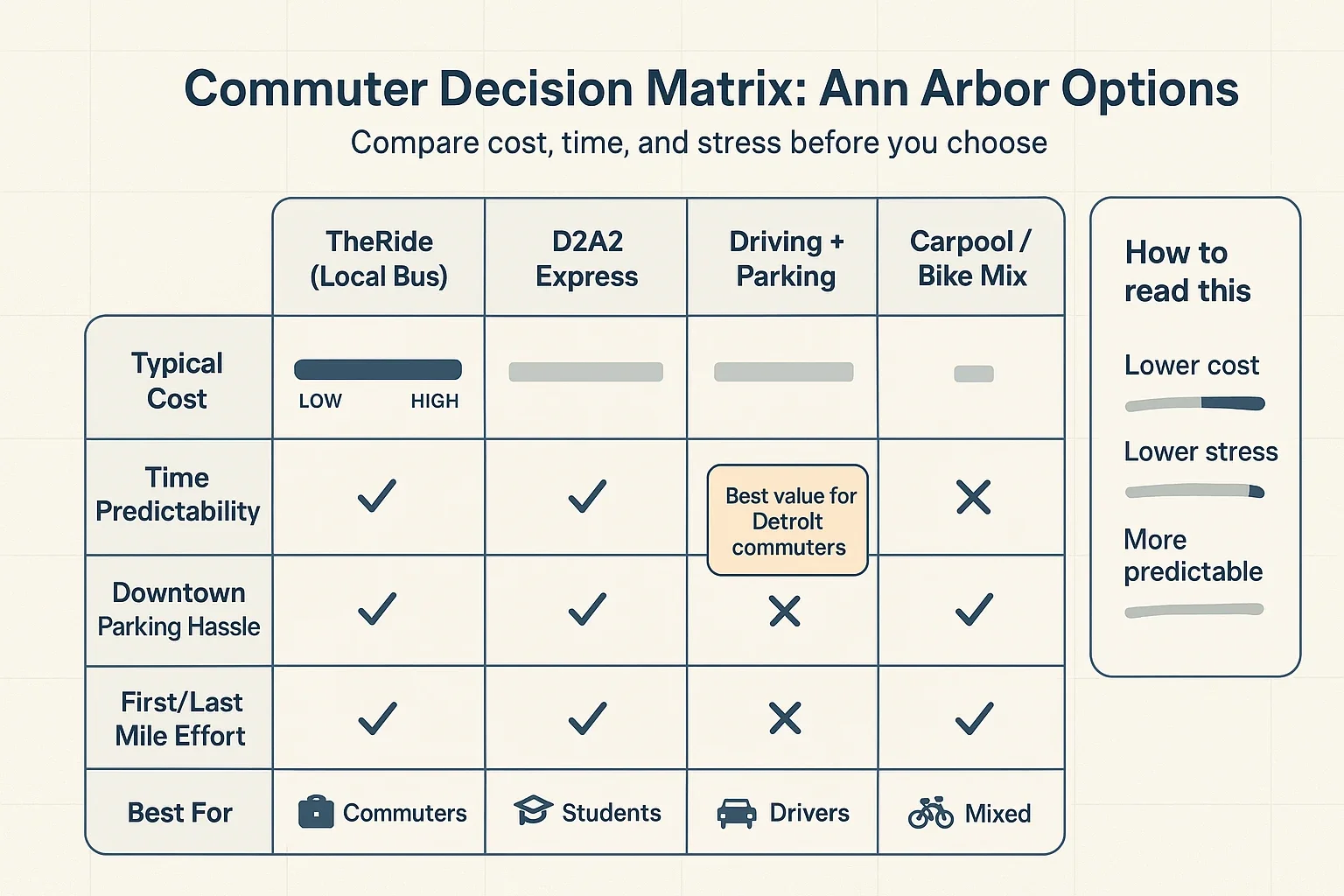
The Commuter Decision Matrix
Before committing to a monthly parking pass or a vehicle purchase, it is vital to assess the “friction factors” of local travel. While institutional sites like U-M Parking & Transportation Services (PTS) or TheRide.org provide excellent raw data, they rarely compare modes against one another.
We find that most successful commuters build their strategy around three variables:
Reliability: Can I guarantee my arrival time?
Cost: What is the total cost of ownership (Fare vs. Gas + Insurance + Parking)?
Productivity: Is my commute “dead time” or usable time?
Current data indicates a significant shift in local behavior. Transit ridership in Ann Arbor has recovered to 75-80% of pre-pandemic levels, with fixed-route usage jumping 33% year-over-year according to 2025 performance reports. This surge suggests that for many, the “stress tax” of driving into the city core is no longer worth paying.
The Detroit-Ann Arbor Corridor: Calculating the D2A2 Advantage
For professionals splitting time between Detroit and Ann Arbor, the D2A2 express bus service (operated by the Regional Transit Authority and Michigan Flyer) has fundamentally changed the commuter calculus.
If you are driving this route daily, you are likely factoring in gas and wear-and-tear. However, the hidden killer is parking. Daily parking in Ann Arbor Downtown Development Authority (DDA) structures averages $1.20 to $1.50 per hour. A standard workday can easily result in $12–$15 in daily parking fees—roughly $3,000 annually.
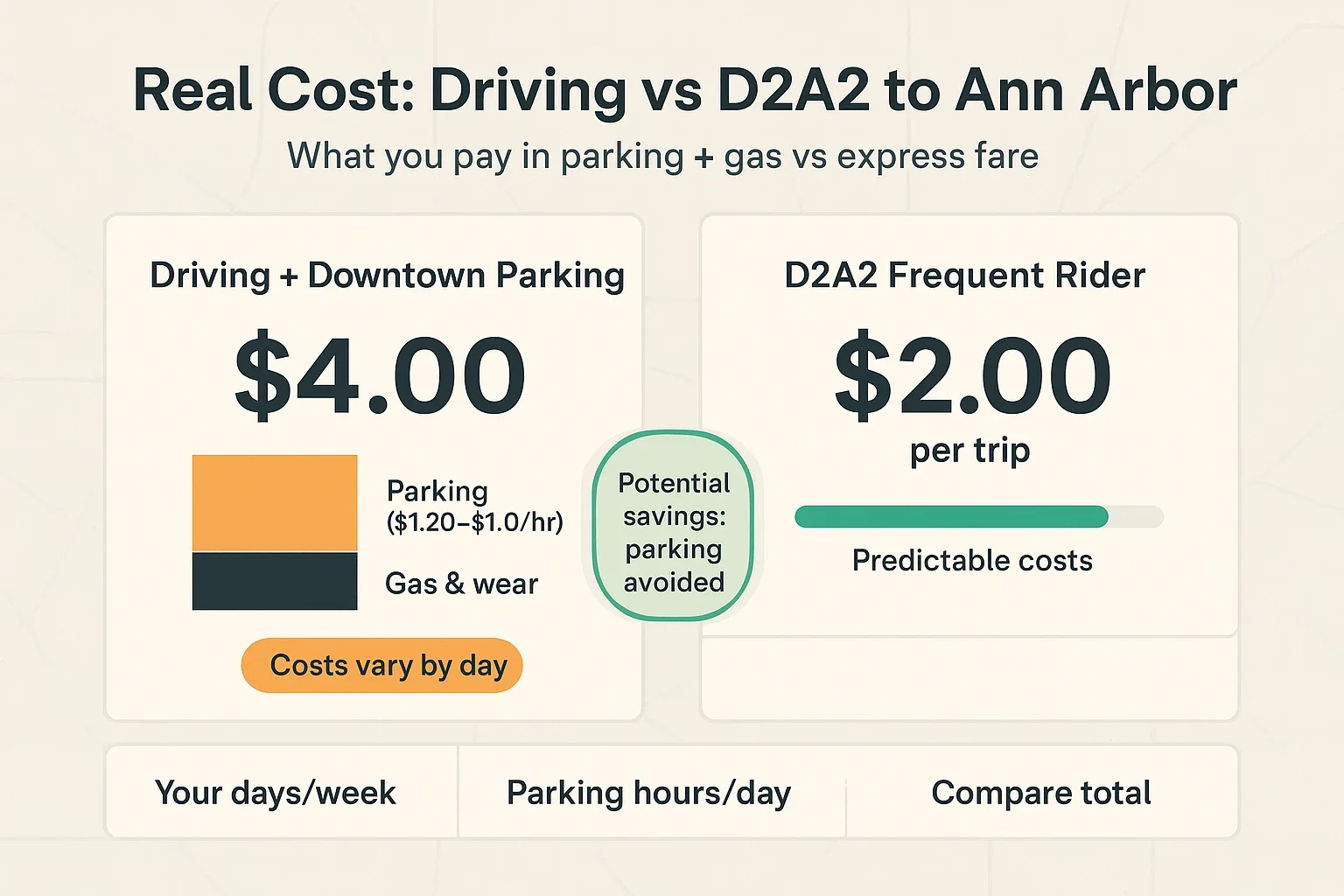
The Cost-Benefit Breakdown
By utilizing the D2A2 “Frequent Rider” pass, the cost per trip drops to approximately $2.00. This creates a massive financial delta:
Driving Scenario: Gas + Wear + $15 Parking = ~$25+ per day.
D2A2 Scenario: $4.00 Round Trip per day.
Beyond the finances, the “Transit Royale” app integration allows for seat reservations and real-time tracking, removing the anxiety of “will there be a spot for me?” This reliability is why we see high adoption rates among hybrid workers who visit the office 2-3 times a week.
Navigating Local Transit: TheRide (AAATA)
For movement within the greater Ann Arbor area—including connections to satellite communities—TheRide (Ann Arbor Area Transportation Authority) is the primary engine.
While TheRide is reliable, it requires local knowledge to master. The system is designed heavily around hubs: the Blake Transit Center (Downtown) and the Ypsilanti Transit Center.
Smart Commuting from the Periphery
For residents in communities like Whitmore Lake or those living at Chestnut Hills, the most effective strategy is often a hybrid approach. You enjoy the quiet, single-story living and lower density of the outskirts, and utilize US-23 to access the city’s edge, then switch modes to enter the congested core.
Key Highways: US-23 and M-14 are the primary arteries. While efficient, they face predictable congestion during rush hours. This is where the Park & Ride network becomes your greatest asset.
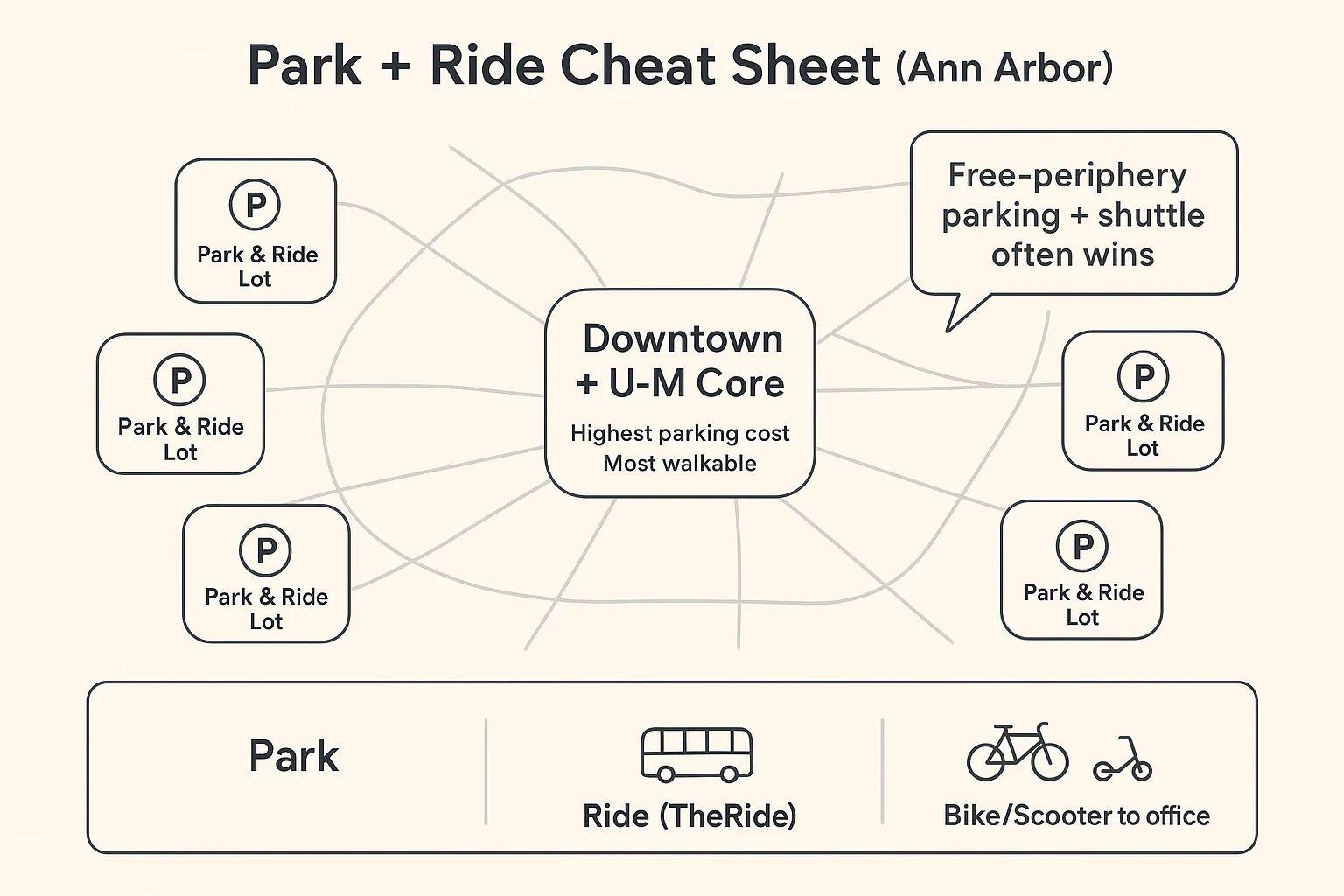
The “Park & Ride” Strategy
If you prefer the independence of your own car but want to avoid the downtown parking scramble, Ann Arbor’s network of seven Park & Ride lots is the solution. These lots are free to park in and are serviced by high-frequency bus routes.
The “Last Mile” Solution
Once you arrive downtown—whether by bus or car—you may still be a mile from your destination. Ann Arbor is incredibly bike-friendly, and the city has heavily integrated micro-mobility options.
Spin Scooters: Widely available for bridging the gap between a parking structure and your office door.
Bike Lanes: The city continues to expand protected bike lanes, making cycling a viable year-round option for the prepared commuter.
Specialized Transit: Understanding Operators
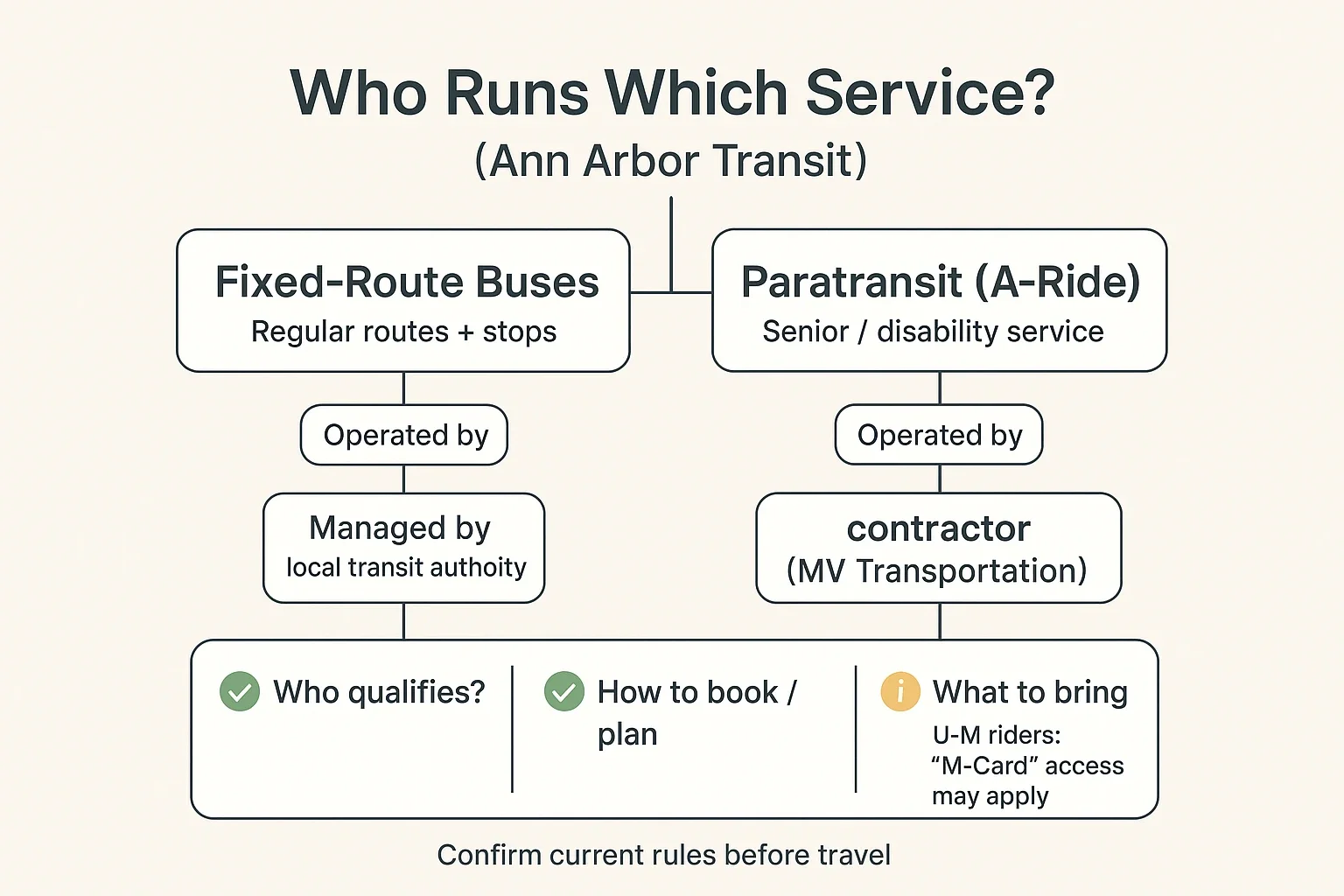
A common source of confusion for new residents—especially those caring for seniors or students—is the mix of brand names involved in specialized transit. You may search for specific services and find names like “MV Transportation” or “Durham School Services.”
It is important to distinguish between the funding agency (TheRide) and the actual operators to ensure you are contacting the right people for reliability and support.
A-Ride (Paratransit): This is a shared-ride service for persons with disabilities who cannot use fixed-route buses.
Who runs it? While it is a service of TheRide, the actual vehicles and drivers are often contracted through MV Transportation. Understanding this helps when you are looking for accountability or specific driver protocols.
Who is it for? This is a vital service for approximately 10% of the population requiring senior or disabled transport support.
Regional Connections: Beyond the City Limits
For residents who need to travel beyond the immediate metro area, Ann Arbor serves as a decent regional hub, though options are specific.
Columbus to Ann Arbor: This route is serviced primarily by Greyhound and Baron’s Bus. It is a popular route for university traffic.
Troy/Suburbs: Commuting to Troy remains a car-dominant activity due to the lack of direct rail, though vanpool resources are available through the Southeast Michigan Council of Governments (SEMCOG).
Frequently Asked Questions
Q: Is the “M-Card” only for students?
A: Primarily, yes. The M-Card allows University of Michigan students and staff to ride AAATA buses for free. If you are not affiliated with the university, you will need to utilize the EZFare app or exact cash.
Q: How bad is the winter commute?
A: Ann Arbor road crews are aggressive with snow removal on major arteries like US-23 and Main Street. However, residential side streets in the city can be slower to clear. This is often where living in a managed community with professional snow removal services offers a distinct advantage over owning a standalone home on a city street.
Q: Can I live in Ann Arbor without a car?
A: Yes, if you live and work downtown. However, most residents find that a hybrid approach—owning a car for weekend trips or grocery runs but using transit for the work commute—offers the best balance of freedom and fiscal responsibility.
Q: What is the “Commuter Challenge”?
A: You may see this referenced in local media. It is an annual month-long event encouraging residents to try alternative modes of transit. It’s a great, low-risk time to test out a bus route or bike lane to see if it fits your lifestyle.
Making the Right Move
Your transportation strategy should dictate where you live, not the other way around. If you value easy highway access to avoid downtown congestion, while still wanting proximity to Ann Arbor’s culture, looking at communities just outside the beltway—like Whitmore Lake—often provides the perfect equilibrium. You gain the square footage and ease of single-story living, with the ability to “opt-in” to the city energy whenever you choose.
Leave a Reply
Your email address will not be published.