
If you are evaluating a move to Ann Arbor, you have likely already encountered the “Michigan Paradox.” You read that Michigan is one of the most affordable states in the country—consistently ranking 5–9% below the national average—yet when you look at real estate listings in Ann Arbor proper, the numbers tell a drastically different story.
This disconnect happens because Ann Arbor functions as an economic “island.” It is a high-value academic and tech hub comparable to Austin or Boston, but it is situated within a low-cost state. For decision-makers and heads of households, this requires a different kind of financial planning. It isn’t enough to look at a generic cost-of-living calculator; you need to understand the structural costs that drive the “Ann Arbor Premium” and how to navigate them.
The following analysis breaks down the real costs of housing, taxation, and lifestyle in Washtenaw County, helping you decide where your budget delivers the highest quality of life.
The “Expensive Island” Effect: By The Numbers
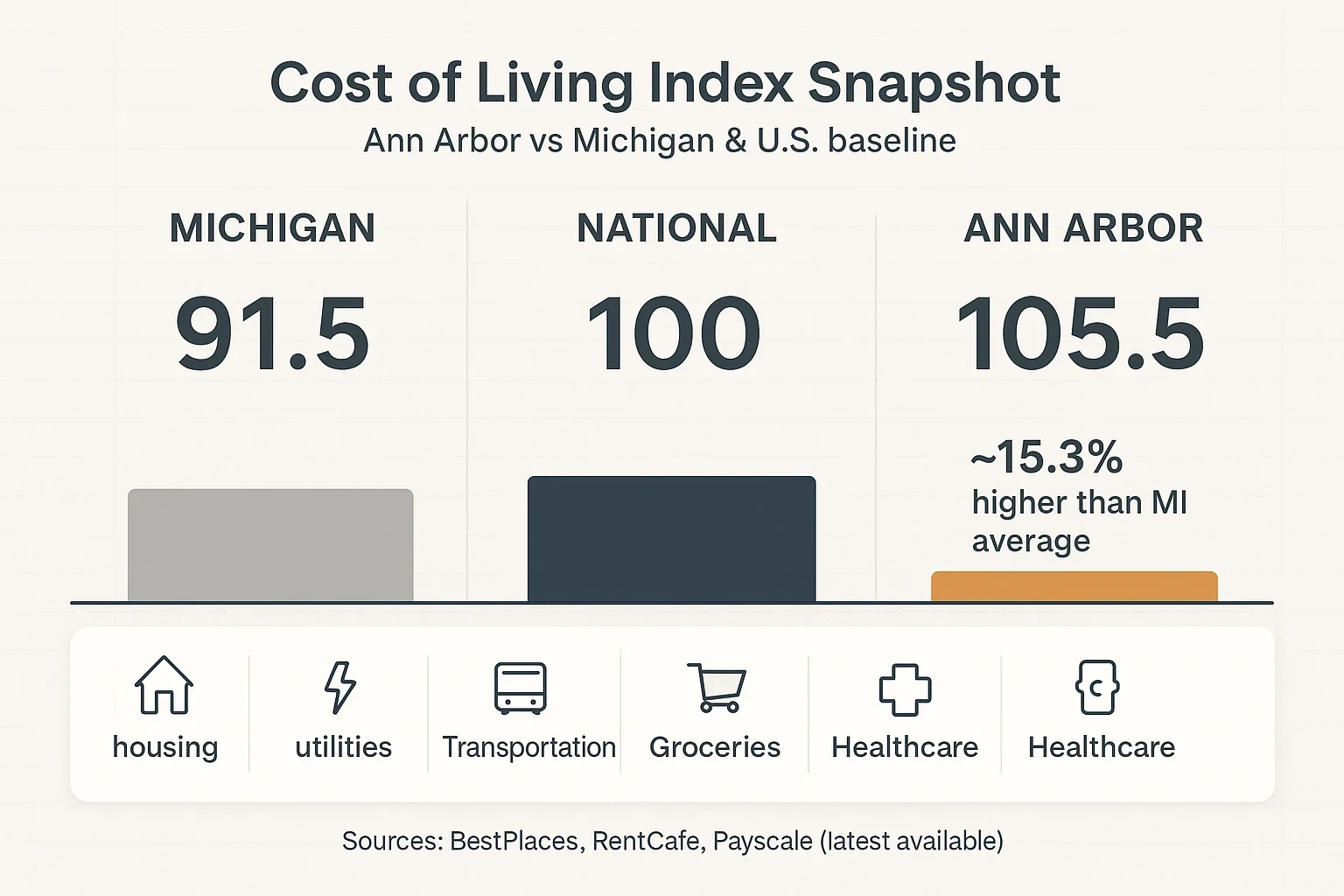
To plan an accurate budget, we first need to isolate Ann Arbor from the rest of the state. While the Michigan cost of living index averages 91.5 (significantly cheaper than the U.S. baseline), Ann Arbor sits at 105.5.
This 14-point spread means that living in Ann Arbor is roughly 15.3% more expensive than living in the average Michigan community. However, this inflation isn’t spread evenly across your budget. You won’t pay 15% more for Netflix or internet access. The cost disparity is driven almost entirely by two specific sectors: Housing and Healthcare.
The Housing Disparity
Housing is the primary driver of Ann Arbor’s cost of living. Median home prices in the city proper hover around $620,000, which is a staggering 108% higher than the Michigan state average of roughly $218,000.
For prospective residents, this creates a specific challenge: finding a home that justifies the price tag. Much of Ann Arbor’s housing stock is older, meaning buyers often pay a premium for location while sacrificing modern amenities like energy efficiency, updated insulation, or single-story accessibility.
The Hidden Cost: The “Welcome Stranger” Tax Reset
If you are looking to buy a home in Washtenaw County, there is a critical line item that Zillow and Redfin calculators almost always get wrong: Property Taxes.
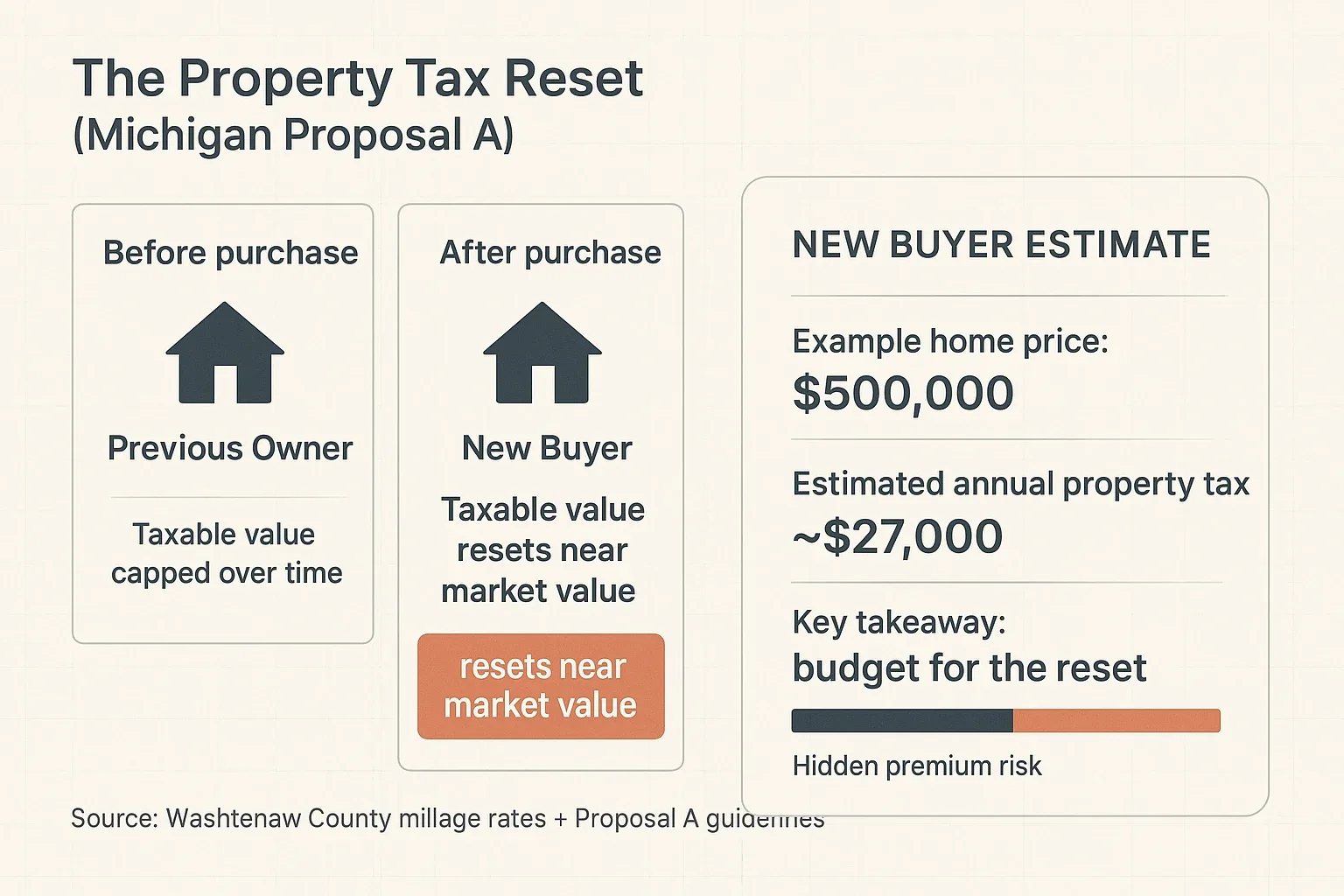
Michigan operates under a unique law known as Proposal A. This legislation caps the increase in taxable value for current homeowners, often keeping their taxes artificially low the longer they stay in the home. However, when a property is sold, the taxable value uncaps and resets to roughly 50% of the current market value.
This is known as the “Welcome Stranger” effect.
Why this matters for your evaluation:
If you buy a $500,000 home in Ann Arbor, your property taxes could easily reset to $12,000–$14,000 annually, regardless of what the previous owner was paying. This creates a compelling argument for leasing options or new developments in nearby communities like Whitmore Lake. Renting allows you to lock in monthly housing costs without exposure to variable tax resets or unexpected maintenance on older structures.
Healthcare and Utilities: The Outliers
While housing grabs the headlines, two other categories significantly impact the local cost of living index.
1. The Healthcare Premium (+27%)
Ann Arbor is home to the world-class University of Michigan Health System. Access to elite medical care is a major benefit, but it comes with a cost. Healthcare indices for the area track 27% higher than the national average. For retirees or families with ongoing medical needs, this is a vital budget consideration.
2. The Efficiency Opportunity
Conversely, utilities in the region can be a source of savings—if you choose the right home. While older Victorian homes in downtown Ann Arbor are notorious for energy leakage (and high heating bills during Michigan winters), modern construction offers a massive advantage.
Communities built with 2×6 framing, closed-cell foam insulation, and Energy Star-rated appliances—standards upheld by developments like Chestnut Hills—can significantly undercut the regional utility average. When comparing older rentals in the city against modern homes nearby, always ask for the average utility spend; the difference can effectively subsidize your commute.
Ann Arbor vs. Major Tech Hubs
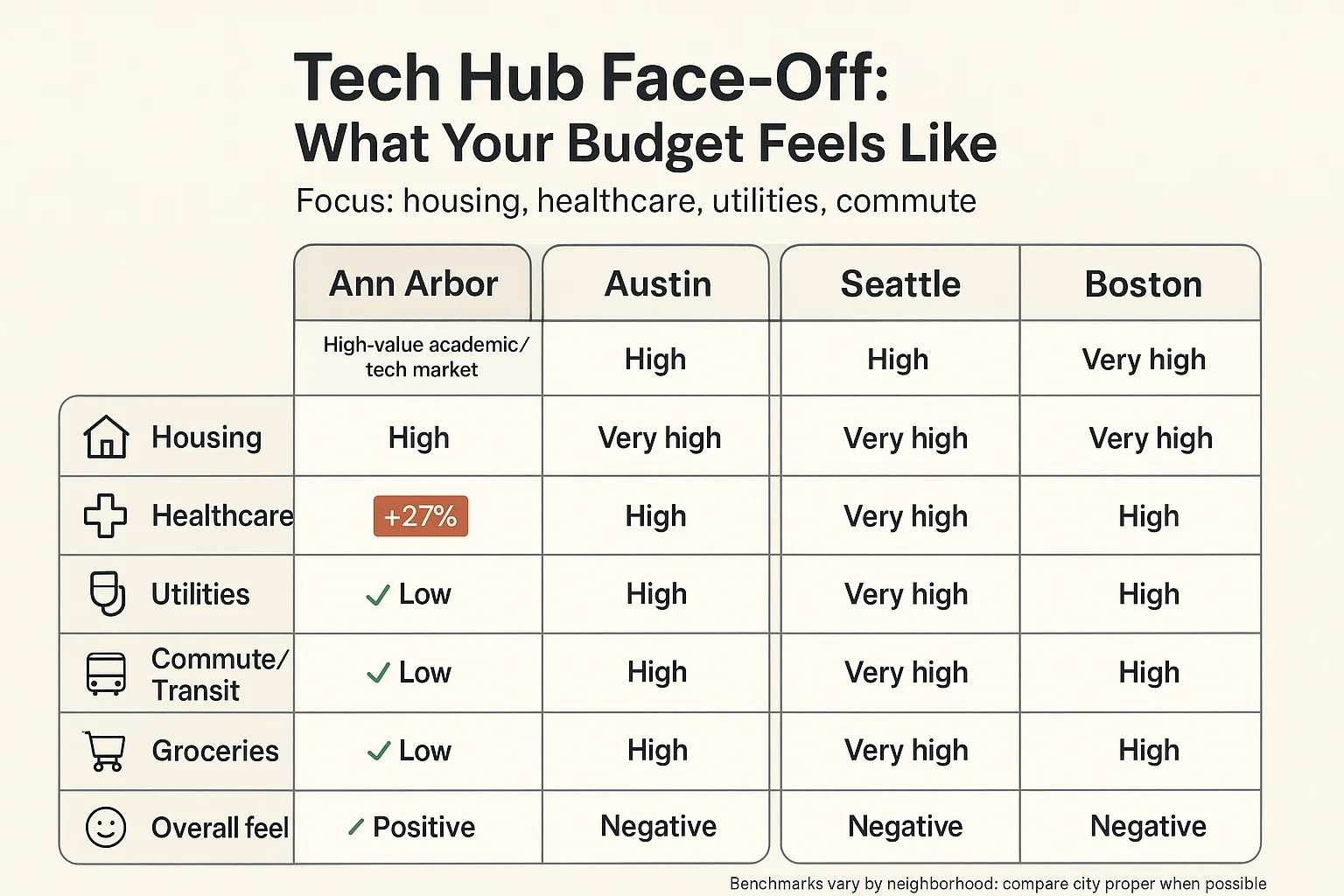
Many of our residents relocate from major coastal hubs or other tech centers. If you are comparing Ann Arbor to cities like Austin, Seattle, or Boston, the value proposition shifts dramatically.
In these comparisons, Ann Arbor transforms from “expensive” to “high value.” You gain access to a similar tier of cultural and intellectual capital—top-tier universities, tech employment, and walkable downtowns—at a fraction of the cost.
Strategic Budgeting: Location Matters
The smartest financial move for many professionals is to capitalize on the “Township Strategy.”
Ann Arbor City limits impose the highest premiums on tax and rent. However, just minutes outside the city limits—in areas like Whitmore Lake—costs stabilize significantly. Residents here enjoy a 10-15 minute commute to downtown Ann Arbor but benefit from lower density, newer infrastructure, and more competitive pricing.
For example, choosing a community in Whitmore Lake offers:
More Space: Direct access two-car garages and personal patios are standard, features that are rare or exorbitantly priced in downtown apartments.
Modern Living: Single-story layouts with vaulted ceilings vs. multi-story walk-ups.
Financial Predictability: Avoiding the volatility of city property taxes and older-home maintenance.
Income Requirements for a Comfortable Lifestyle
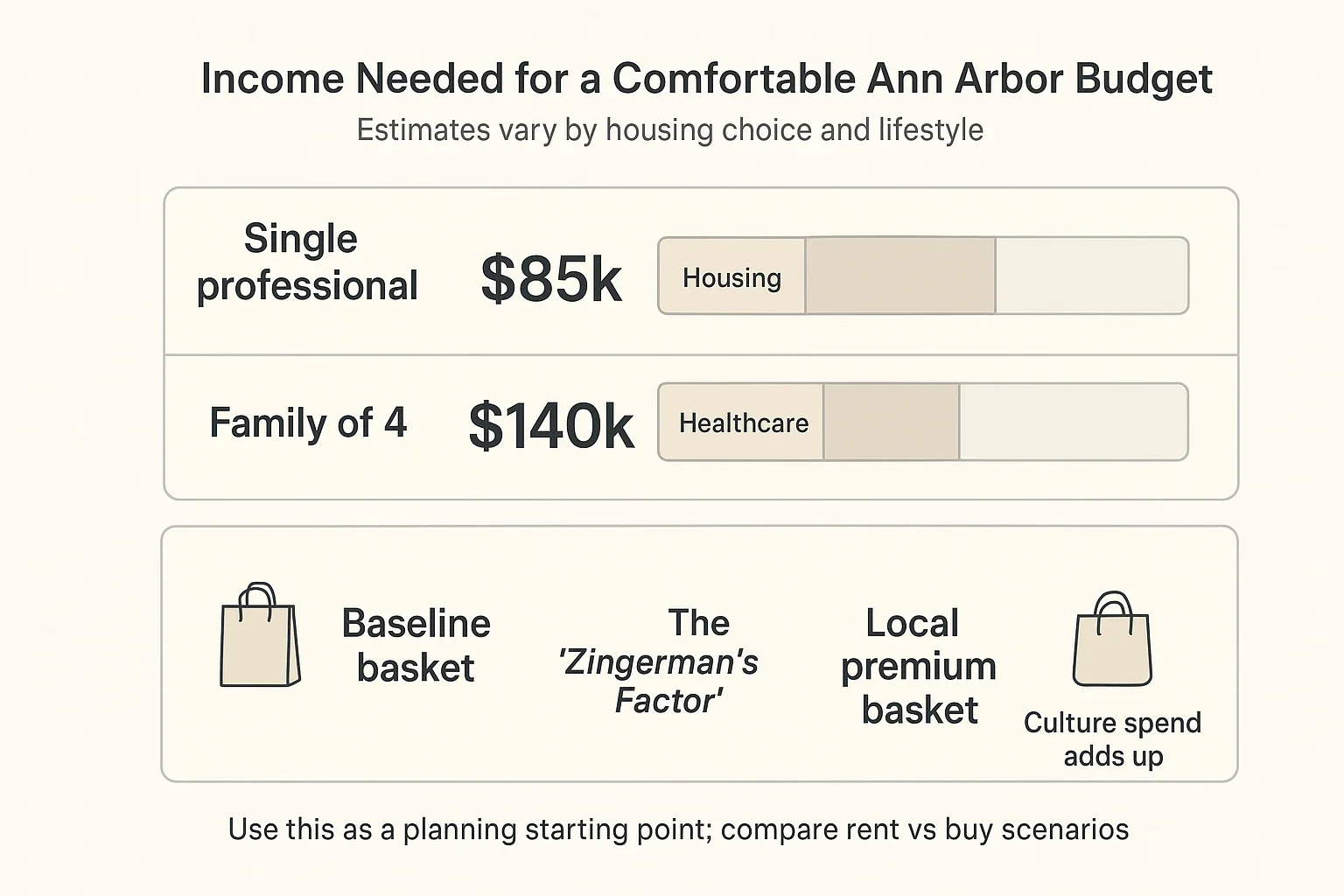
What does it actually cost to live comfortably here? “Comfort” is subjective, but based on current data for housing, transportation, and discretionary spending (the “Zingerman’s Factor”), here is a realistic baseline for the greater Ann Arbor area.
Frequently Asked Questions
Q: Is the cost of living in Ann Arbor increasing faster than the national average?
A: Yes, largely due to housing scarcity. As the University of Michigan expands and the local tech sector grows, demand for housing within the city limits outpaces supply. This makes “near-city” communities like Chestnut Hills increasingly attractive for locking in value.
Q: Does renting make more financial sense than buying in this market?
A: For many, yes. Between interest rates and the “Welcome Stranger” property tax reset, the monthly carry cost of buying a median-priced home can be significantly higher than renting a luxury apartment home. Renting allows you to invest your surplus capital elsewhere while avoiding maintenance costs.
Q: How much should I budget for utilities in winter?
A: In older housing stock, heating bills can spike to $300+ in January. However, in energy-efficient builds with 2×6 construction and proper insulation, these costs are drastically reduced. We recommend budgeting closer to the national average if you choose a modern, energy-star-rated home.
The Verdict: Maximizing Value
Ann Arbor is an exceptional place to live, but paying the “Index Premium” isn’t necessary to enjoy it. By understanding the mechanics of property taxes and prioritizing modern, energy-efficient housing just outside the city center, you can access the Ann Arbor lifestyle without the inflated costs.
The most satisfied residents are often those who find the sweet spot: close enough for dinner on Main Street, but far enough to enjoy a two-car garage, quiet surroundings, and a smarter monthly budget.
Leave a Reply
Your email address will not be published.
