The 2025-2026 Guide to Washtenaw County Schools: Navigating Stability, Strategy, and Choice
For families evaluating a move to the greater Ann Arbor area, the conversation used to be simple: “Get into the Ann Arbor Public Schools (AAPS) district.” For decades, that was the gold standard.
But if you are reading this today, you likely know that the landscape has shifted. You aren’t looking for a glossy brochure; you are looking for a strategy.
The 2025 academic year introduced a level of volatility that standard school ranking sites—like Niche or GreatSchools—haven’t caught up with yet. With AAPS navigating a publicized $25 million budget shortfall and the resulting 141 staff layoffs, the primary concern for parents has shifted from “ranking” to “stability.”
At Chestnut Hills, we understand that your home is the foundation of your life, but the school system is the scaffolding of your daily routine. We believe you deserve a transparent, data-backed look at your options—from the shifting public landscape to the private school investment—so you can make a decision rooted in confidence, not just geography.
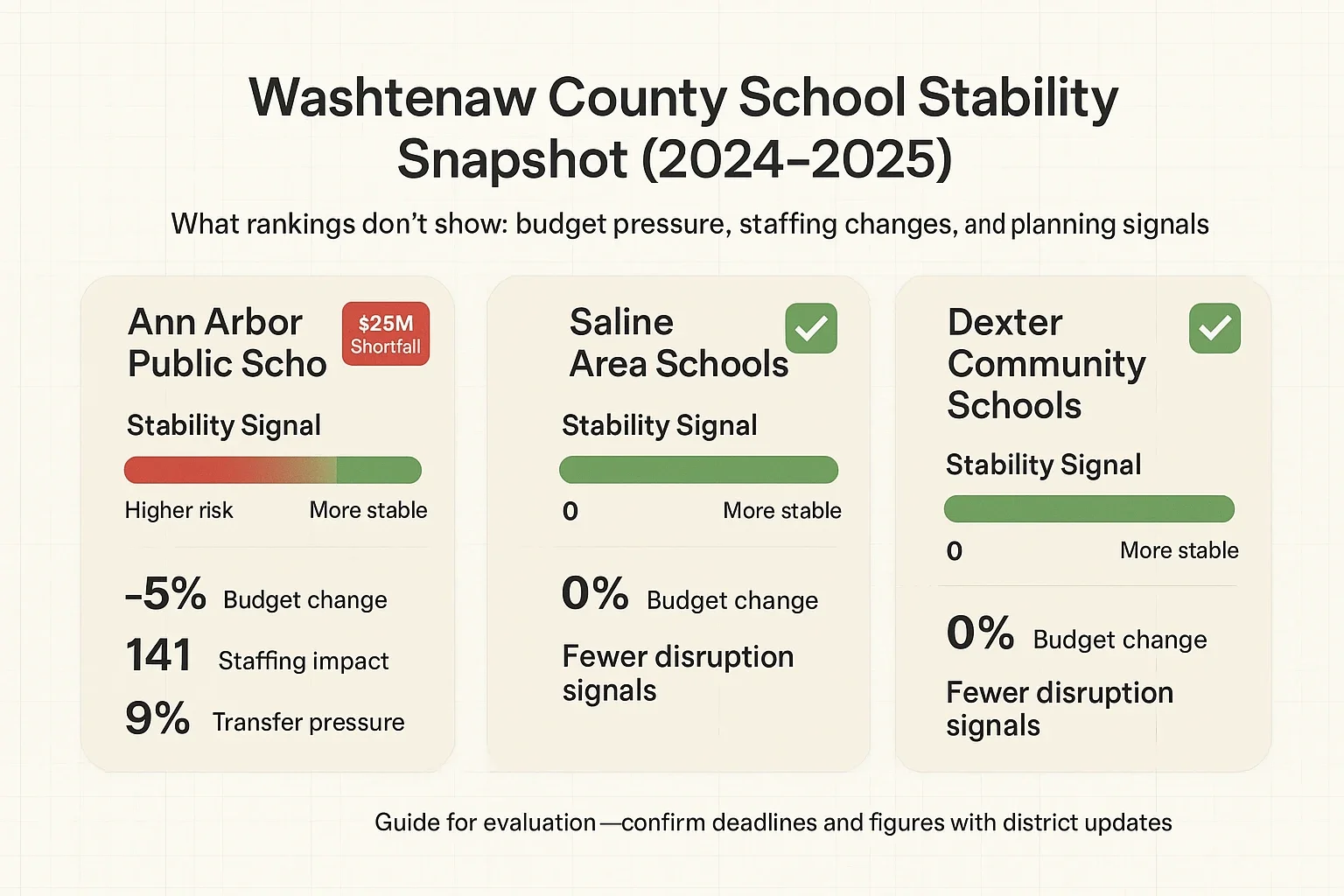
The Stability Gap: A New Evaluation Framework
When evaluating districts in Washtenaw County, it is crucial to look beyond historical test scores and examine operational health. This is what we call the “Stability Gap.”
While AAPS remains an academic powerhouse with proficiency rates well above the state average, the operational friction has increased. This has led many families to broaden their search to the “Outer Ring” districts like Saline and Dexter, or to reconsider the value proposition of private education.
Ann Arbor Public Schools (AAPS)
The Status: High Performance, High Friction.
The Reality: Despite the turmoil, AAPS students still average 48% math proficiency, significantly outperforming the Michigan average of 35%. The academic rigor is there. However, the reduction of 141 positions creates uncertainty regarding class sizes, elective availability, and support staff availability.
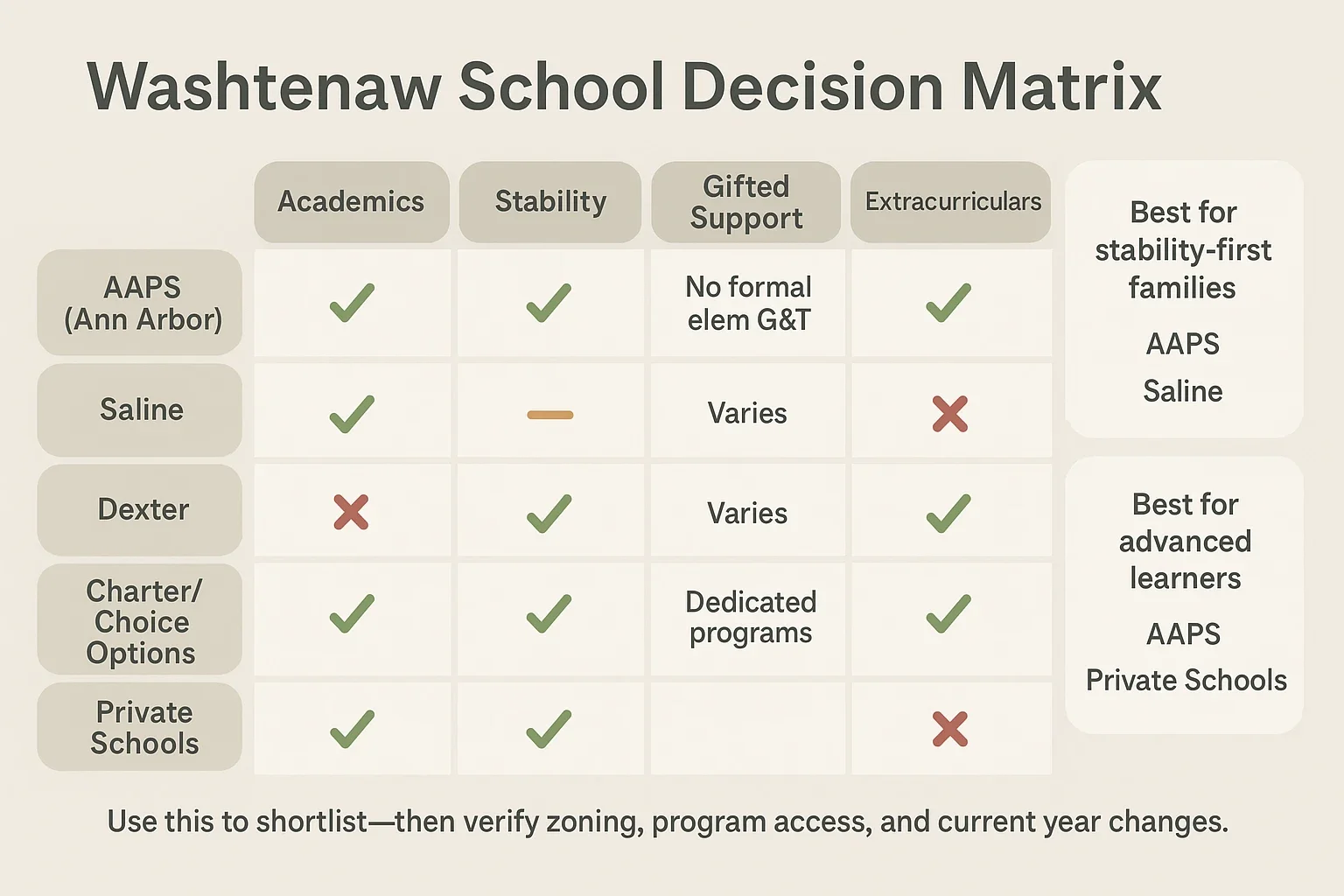
Best For: Families who need specific, niche extracurriculars that only a massive district can provide, and who are willing to navigate a more complex administrative environment.
Saline Area Schools & Dexter Community Schools
The Status: The Stable Challengers.
The Reality: These districts have absorbed much of the “flight” from Ann Arbor. They offer comparable academic rigor but currently boast more predictable budget cycles. Saline, in particular, is often lauded for its strong science and robotics programs, while Dexter offers a blend of rural community feel with high-tech learning environments.
Best For: Families seeking a traditional “community school” feel where the administrative pathways are clearer and stability is the priority.
Whitmore Lake Public Schools
The Status: The Personalized Community Option.
The Reality: For residents of Chestnut Hills, this is your local district. Smaller class sizes mean your student isn’t just a number. While they may not have the massive course catalog of AAPS, the teacher-to-student connection is often stronger, and the community integration is seamless.
Best For: Families who value close-knit environments and direct access to teachers and administration.
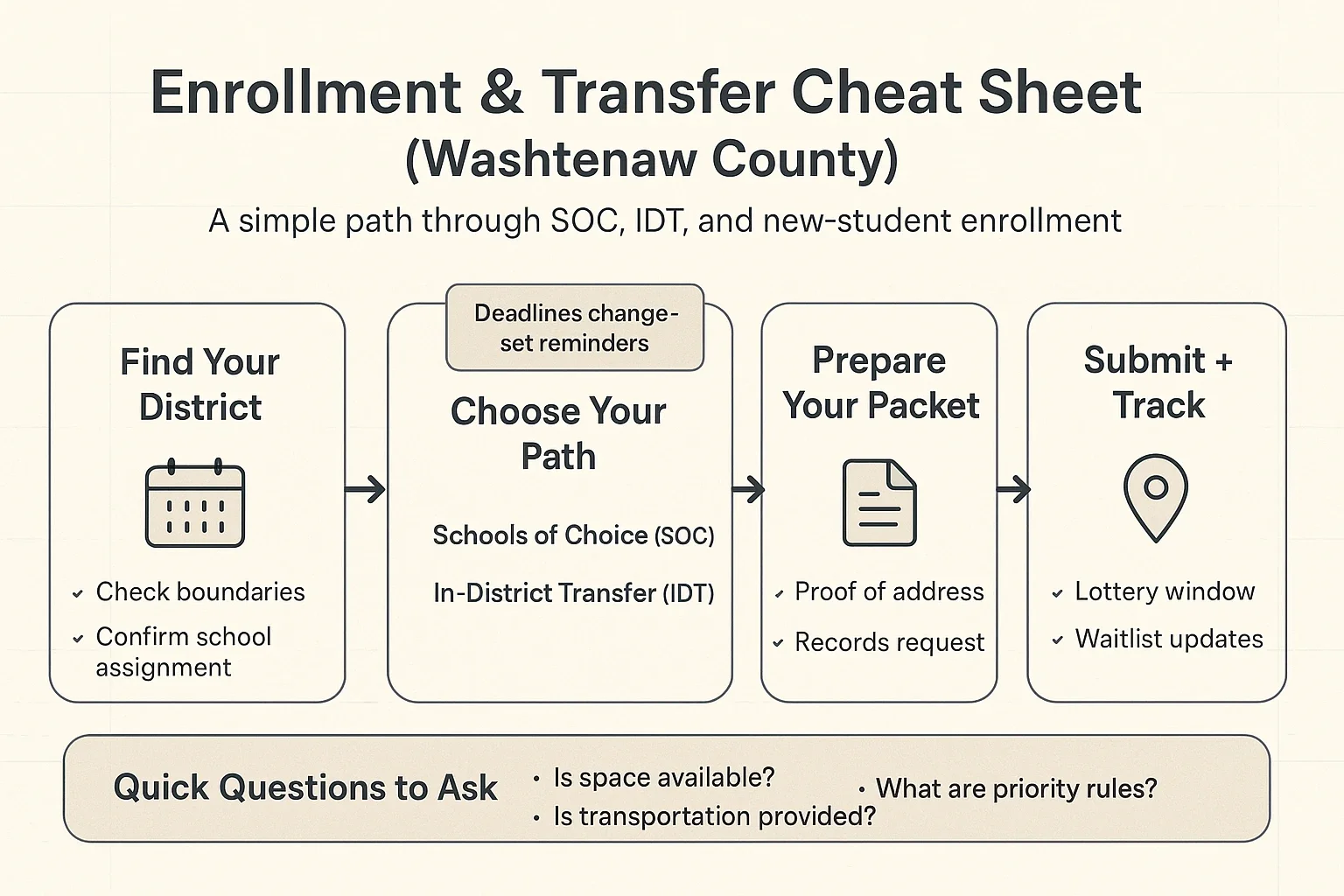
Mastering the Enrollment Maze
One of the biggest frustrations we hear from new residents is the opacity of the enrollment process. Official district websites are often cluttered with PDFs and jargon. If you are considering a district outside of your assigned residence—using Schools of Choice (SOC)—or trying to move within AAPS using In-District Transfer (IDT), timing is everything.
The “Schools of Choice” Window
Michigan’s Schools of Choice program allows you to enroll your child in a district other than the one you reside in, provided that district has opened seats.
The Catch: Districts like Saline and AAPS cap these spots rigidly. They are often determined by lottery.
The Timing: Windows usually open in late spring (May/June) for the following fall. Missing a deadline by one day often means waiting a full year.
AAPS In-District Transfers
If you live within the AAPS boundaries but want a specific school (e.g., Open School or STEAM), you enter a lottery.
Risk Factor: With the current budget cuts, “space available” transfers may become tighter as the district consolidates resources to maximize class sizes.
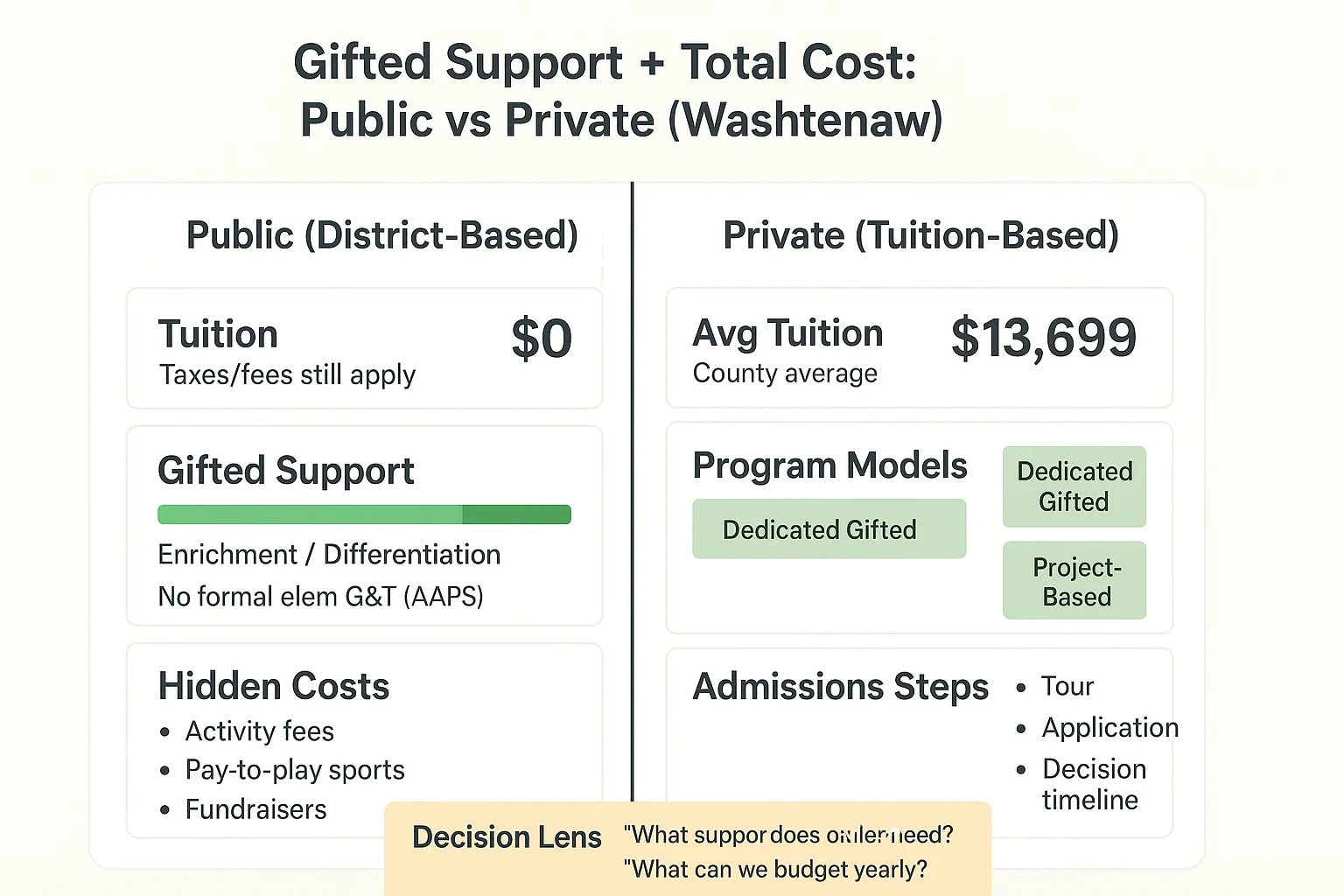
The Private School & Gifted Education Calculation
A major driver for families moving to the area is the search for advanced specialized support. Here, a distinct gap exists between public marketing and classroom reality.
The Gifted & Talented (G&T) Void
Many parents assume AAPS has a formal, separate “Gifted” track in elementary school. They do not. The district relies on “differentiation”—teaching to various levels within a single classroom. While some teachers excel at this, forums and parent feedback consistently highlight that high-ability students can feel stagnant without a dedicated curriculum.
The Private Alternatives
This “G&T Void” drives many families toward private institutions like Emerson School (known for its gifted focus) or Greenhills (college prep).
The Investment: The average private school tuition in Washtenaw County hovers around $13,699, with top-tier options exceeding that.
The Calculus: Parents must weigh this cost against the “hidden costs” of public schools (pay-to-play sports fees, potential tutoring to bridge gaps) and the value of smaller class sizes protected from public budget cuts.
Special Education and the WISD Factor
For families requiring an Individualized Education Program (IEP), the Washtenaw Intermediate School District (WISD) acts as the regional service agency. Regardless of which local district you choose (AAPS, Whitmore Lake, or Dexter), WISD manages many of the specialized services.
Strategic Insight: Smaller districts like Whitmore Lake sometimes offer easier access to administration for IEP meetings, whereas larger districts like AAPS have more specialized on-staff therapists but a larger bureaucracy to navigate.
Frequently Asked Questions
Q: Will the AAPS budget cuts affect my child’s classroom experience?
A: Likely, yes. The reduction of 141 staff members generally translates to larger class sizes and fewer support staff (like paraprofessionals) in the hallways and lunchrooms. Core academics remain strong, but the “extras” are being squeezed.
Q: Is it difficult to get into Saline schools if we live in Whitmore Lake?
A: It depends on the year. Saline participates in Schools of Choice, but they are selective about how many seats they open based on their own capacity. You must apply during the specific window (usually May/June).
Q: Does Chestnut Hills fall within the AAPS boundaries?
A: Chestnut Hills is located in Whitmore Lake. This offers a unique advantage: you have a dedicated, intimate local school system (Whitmore Lake Public Schools) as your guaranteed right, while remaining geographically positioned to utilize Schools of Choice for Ann Arbor, Brighton, or Dexter if those align better with your specific needs.
Making Your Move with Confidence
Choosing a school system is about managing risk and maximizing opportunity. Whether you opt for the massive resources of Ann Arbor, the stability of Saline, or the personalized attention of Whitmore Lake, your home base matters.
At Chestnut Hills, we provide the stability that balances the external chaos. With energy-efficient, single-story designs and a community rooted in quiet comfort, you have the perfect sanctuary to retreat to after the school run.
Ready to secure your home base in Washtenaw County? Explore our floor plans today and see how single-story living supports your family’s lifestyle.
Leave a Reply
Your email address will not be published.