Moving to the Ann Arbor area involves more than just hiring a truck and unpacking boxes. It requires navigating a specific set of administrative hurdles, from understanding Washtenaw County’s utility ecosystem to managing Michigan’s strict vehicle registration laws.
You aren’t looking for a generic “remember to pack your toothbrush” list. You need a logistical execution plan that ensures your transition is seamless, financially sound, and legally compliant from day one.
Whether you are relocating for a position at the University, the hospital systems, or the growing tech sector, the difference between a stressful move and a successful one is strategy. This guide transforms the chaos of relocation into a timeline-based protocol, designed to get you settled into your new home efficiently.
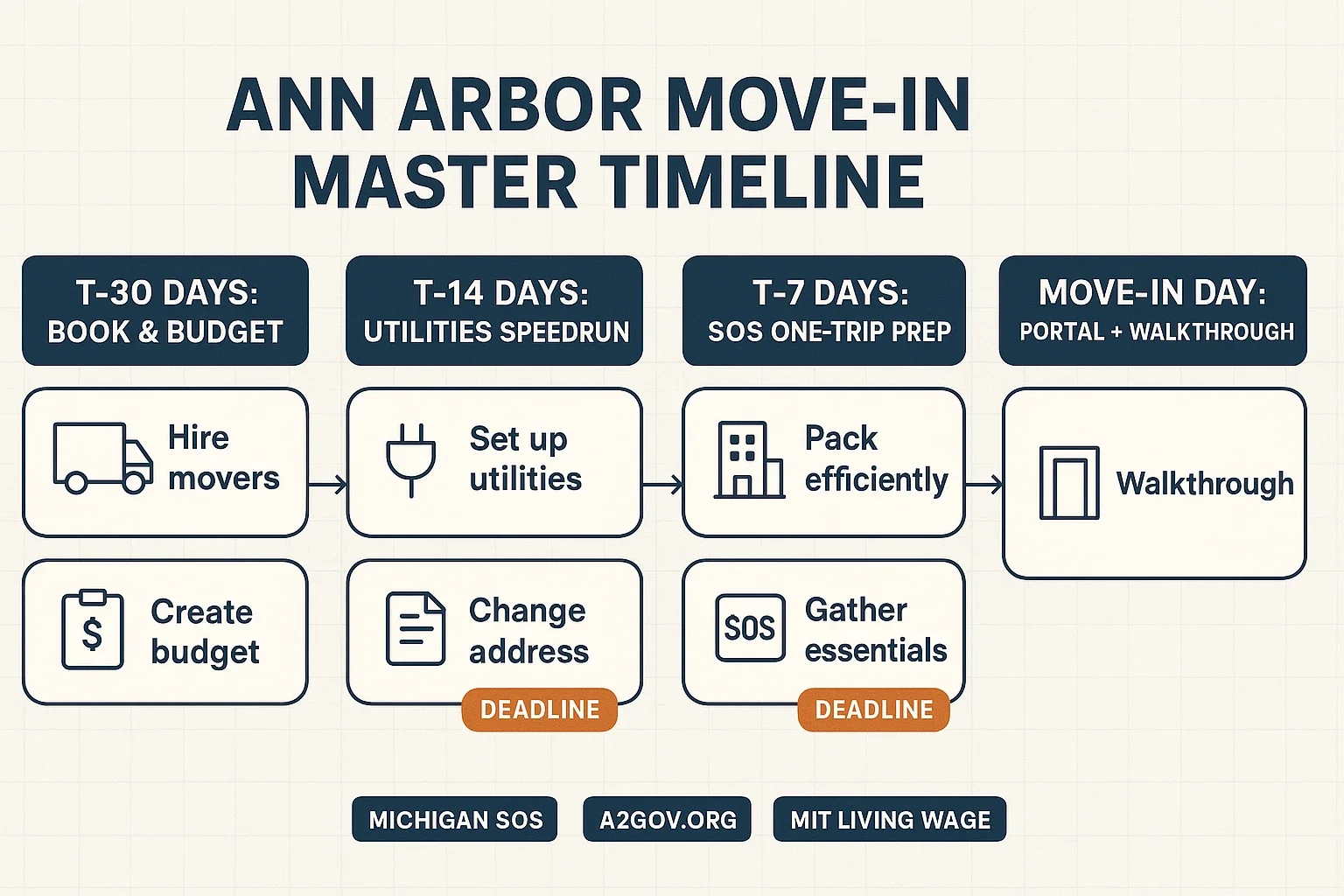
Phase 1: The “T-Minus 30” Master Timeline
The biggest mistake new residents make is treating tasks sequentially rather than strategically. To avoid service gaps—like arriving to a dark apartment or paying for rush fees—you need to operate on a countdown.
Week 4: The Negotiation Window
Many incoming residents don’t realize that moving quotes in this region are often negotiable, much like purchasing a vehicle. When contacting local providers like Two Men and a Truck or Wondermove, request competing quotes. If you are moving during the off-season (late autumn or winter), you have significant leverage. Secure your date now; Ann Arbor’s lease turnover cycle is aggressive, and trucks book out weeks in advance.
Week 2: The Administrative Shift
This is when you initiate your change of address with the USPS. Simultaneously, if you are moving into a managed community like Chestnut Hills, this is the time to log into your resident portal. You will want to review community specific “Move-In Day Hacks”—such as where to park the moving truck to avoid blocking fire lanes or neighbor garage access.
Week 1: The Utility “Speedrun”
Do not wait until the day before move-in. DTE Energy (the primary provider for electricity and gas in Southeast Michigan) allows you to schedule service transfer online.
Action: Schedule your transfer for the day before your lease begins. This ensures the heat is on and the refrigerator is cold when you walk through the door.
Internet: Comcast Xfinity and AT&T Fiber are the primary players here. Installation appointments can lag by 3-5 days during peak seasons, so book this the moment you have a firm move-in date.
Phase 2: The SOS “One-Trip” Strategy
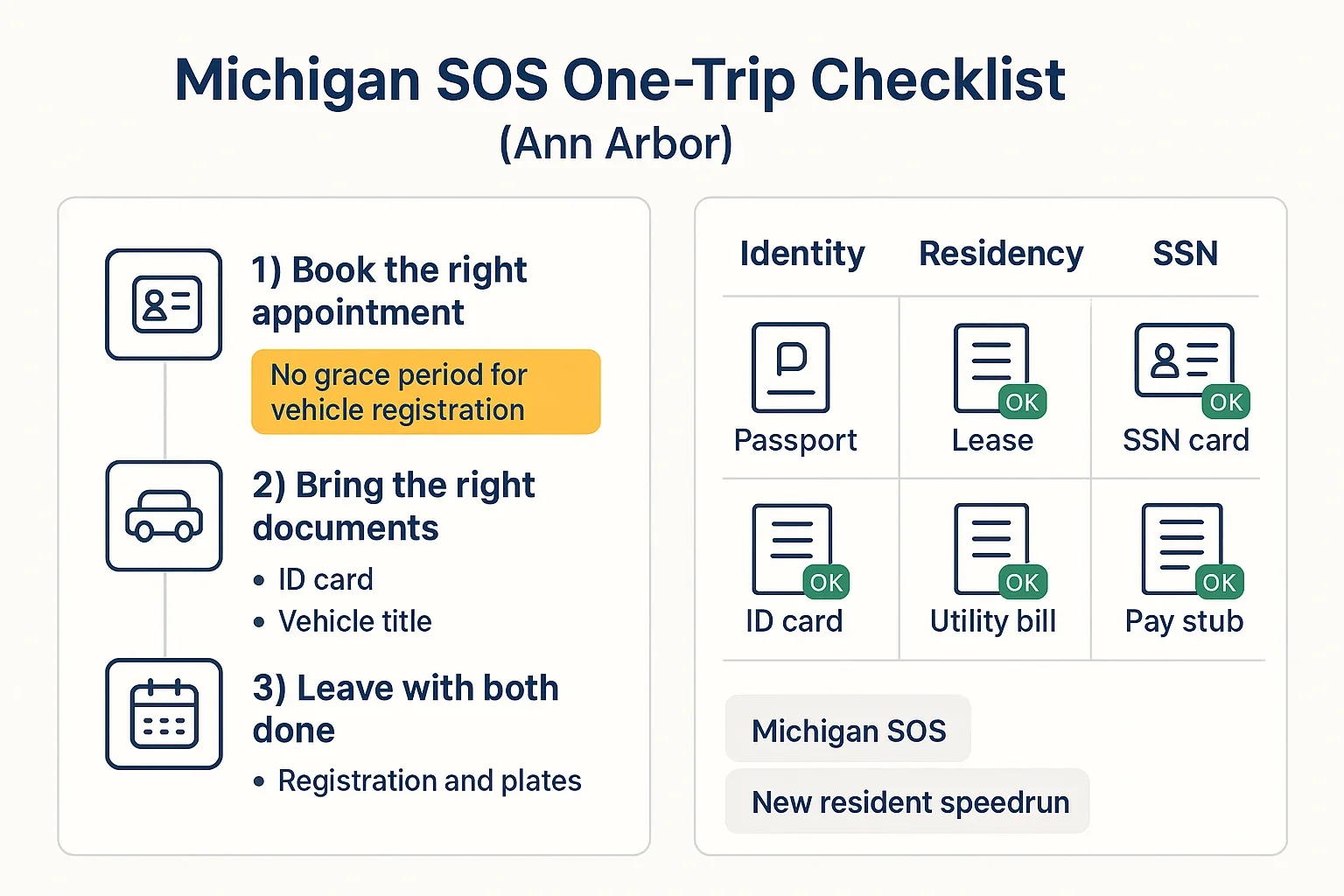
Michigan’s Secretary of State (SOS) offices are notorious for long wait times if you walk in unprepared. Furthermore, Michigan law technically offers no grace period for vehicle registration once residency is established. This is a common pitfall for out-of-state movers who assume they have 30 days.
Your goal is simple: Combine your Driver’s License and Vehicle Title transfer into a single, efficient appointment.
The “One-Trip” Checklist
To walk out with your new license and plates in under an hour, you must bring the correct documentation. If you miss one item, you will be sent home.
1. Proof of Identity (Bring One):
Valid U.S. Passport or Passport Card.
Certified Birth Certificate.
2. Proof of Social Security Number (Bring One):
Social Security Card.
W-2 or 1099 form.
3. Proof of Michigan Residency (Bring Two):
This is where your new lease comes in. A lease agreement serves as a primary proof.
Utility bill (or confirmation of service connection).
Bank statement with your new address.
Pro-Tip: Schedule your appointment online at the michigan.gov/sos website 2 weeks in advance. Look for the “Next Day” slots which open at 8:00 AM and 12:00 PM daily if you need an urgent appointment.
Phase 3: Financial Calibration & Cost of Living
Understanding the local economy is vital for your peace of mind. Ann Arbor and its surrounding townships (like Whitmore Lake) have a distinct economic microclimate compared to the rest of Michigan.
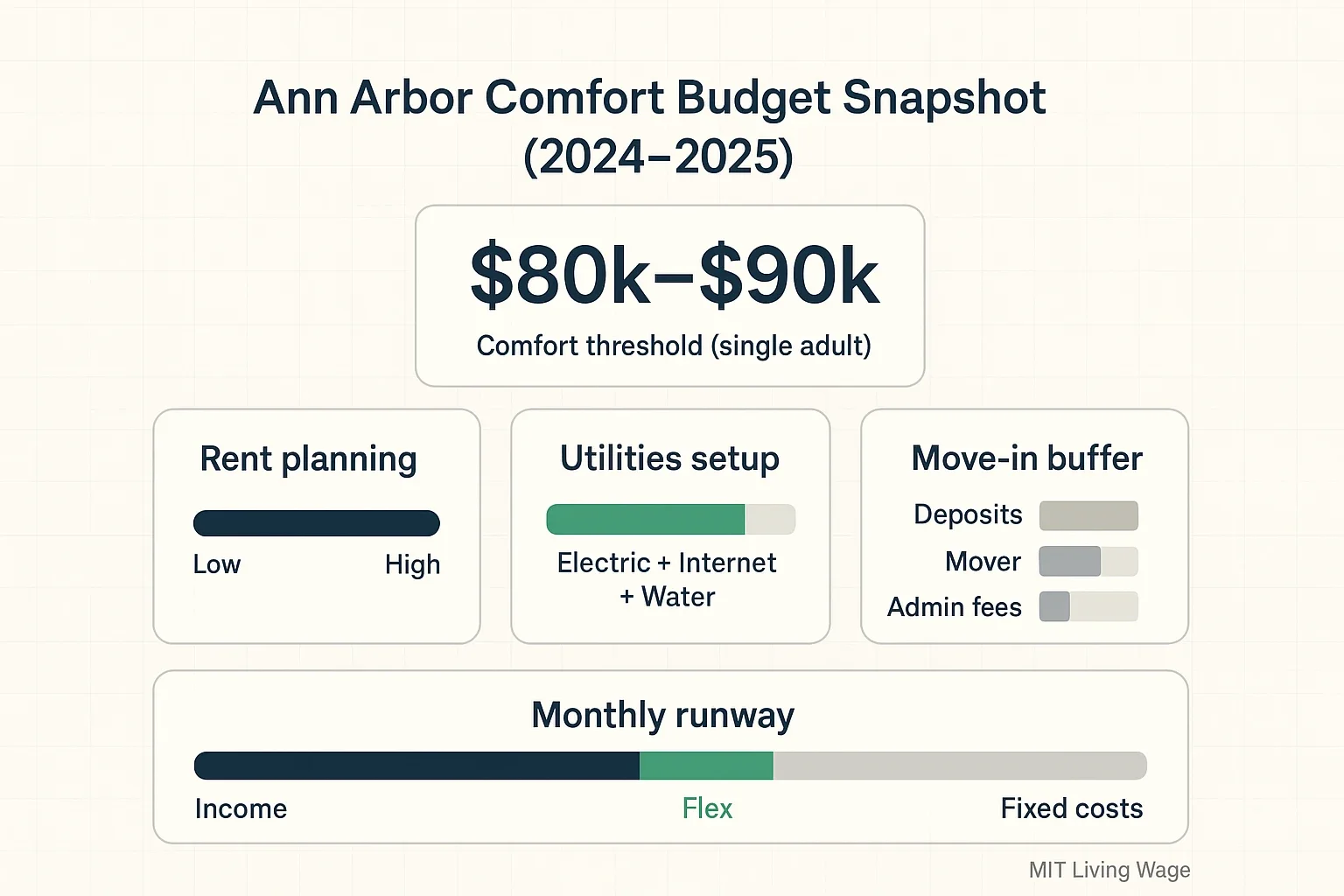
Recent market analytics and MIT Living Wage data suggest that to live “comfortably” in the Ann Arbor area in 2024-2025—meaning you can afford housing, utilities, transportation, and savings without stress—a single adult needs a salary benchmark between $80,000 and $90,000.
The Hidden Costs
When budgeting, many residents account for rent but forget the “efficiency factor.” Older homes in downtown Ann Arbor may have charm, but they often lack insulation, leading to winter heating bills that can exceed $300/month.
This is where the value of energy-efficient construction becomes tangible. Homes built with 2×6 framing, closed-cell foam insulation, and Energy Star-rated appliances—standard features at communities like Chestnut Hills—can drastically lower that monthly overhead, effectively putting money back into your pocket.
Phase 4: Evaluating Your Housing Options
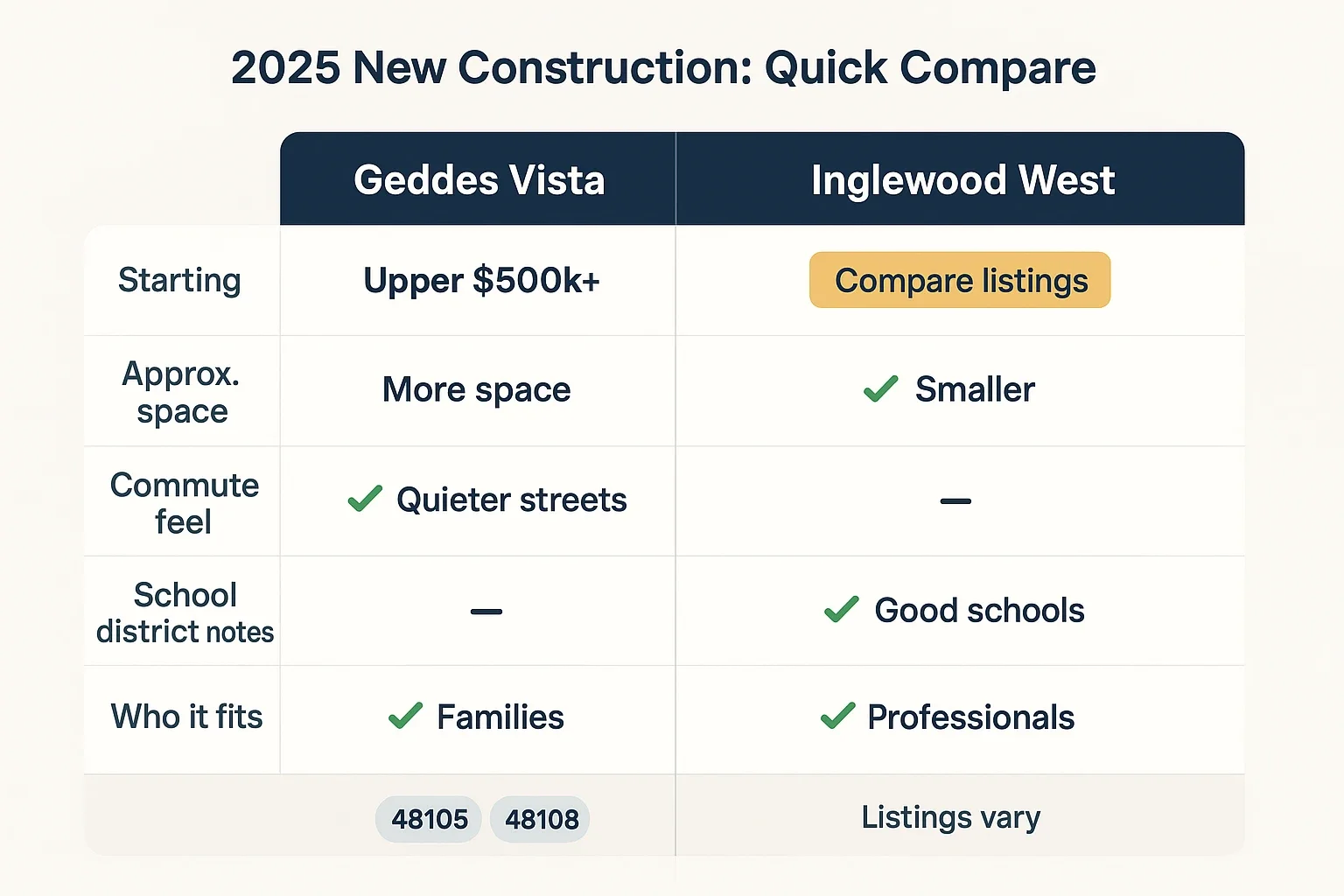
If you are currently evaluating where to live, you are likely noticing a shift in the market. New developments are moving away from downtown density toward the 48108 and 48105 zip codes, as well as Whitmore Lake, to offer more space and better amenities.
Here is how the current “New Construction” landscape compares for 2025:
The “Third Way”: Single-Level Living
While townhomes offer vertical space, they often come with stairs that can become tiresome. The market is seeing a surge in demand for single-story apartment homes. This architectural style, championed by Chestnut Hills, combines the privacy of a single-family home (direct access 2-car garages, personal patios, no upstairs neighbors) with the convenience of managed maintenance.
For residents who value accessibility and ease of entry—getting groceries from the car to the kitchen without climbing stairs—this single-level design offers a significant lifestyle advantage over the multi-story townhomes currently flooding the market.
Frequently Asked Questions
Q: Is there truly no grace period for car registration?
A: Correct. Once you establish residency (usually defined by taking a job or renting a home), Michigan law requires immediate registration. While police may exercise discretion, legally you are at risk of a ticket immediately.
Q: How bad is the winter utility spike?
A: In older homes with poor insulation, it can be severe. In modern, energy-star-rated builds like those at Chestnut Hills, the spike is minimal due to features like flash-and-batt insulation and pre/post-drywall energy seals that prevent drafts.
Q: Why choose Whitmore Lake over downtown Ann Arbor?
A: It comes down to space and pace. Whitmore Lake offers a “retreat” atmosphere—scenic views, less traffic, and quiet—while remaining just a short drive from the cultural and employment hubs of Ann Arbor. You get the urban access without the urban density.
The Final Step
Relocating to the Ann Arbor area is an exciting move into a vibrant community. By following a structured timeline and choosing a home designed for efficiency and comfort, you can skip the stress and start enjoying your new life immediately.
If you are looking for a home that supports this seamless lifestyle—offering the space of a house with the ease of an apartment—we invite you to explore the single-level options at Chestnut Hills. Make your next move your best move.
Leave a Reply
Your email address will not be published.